
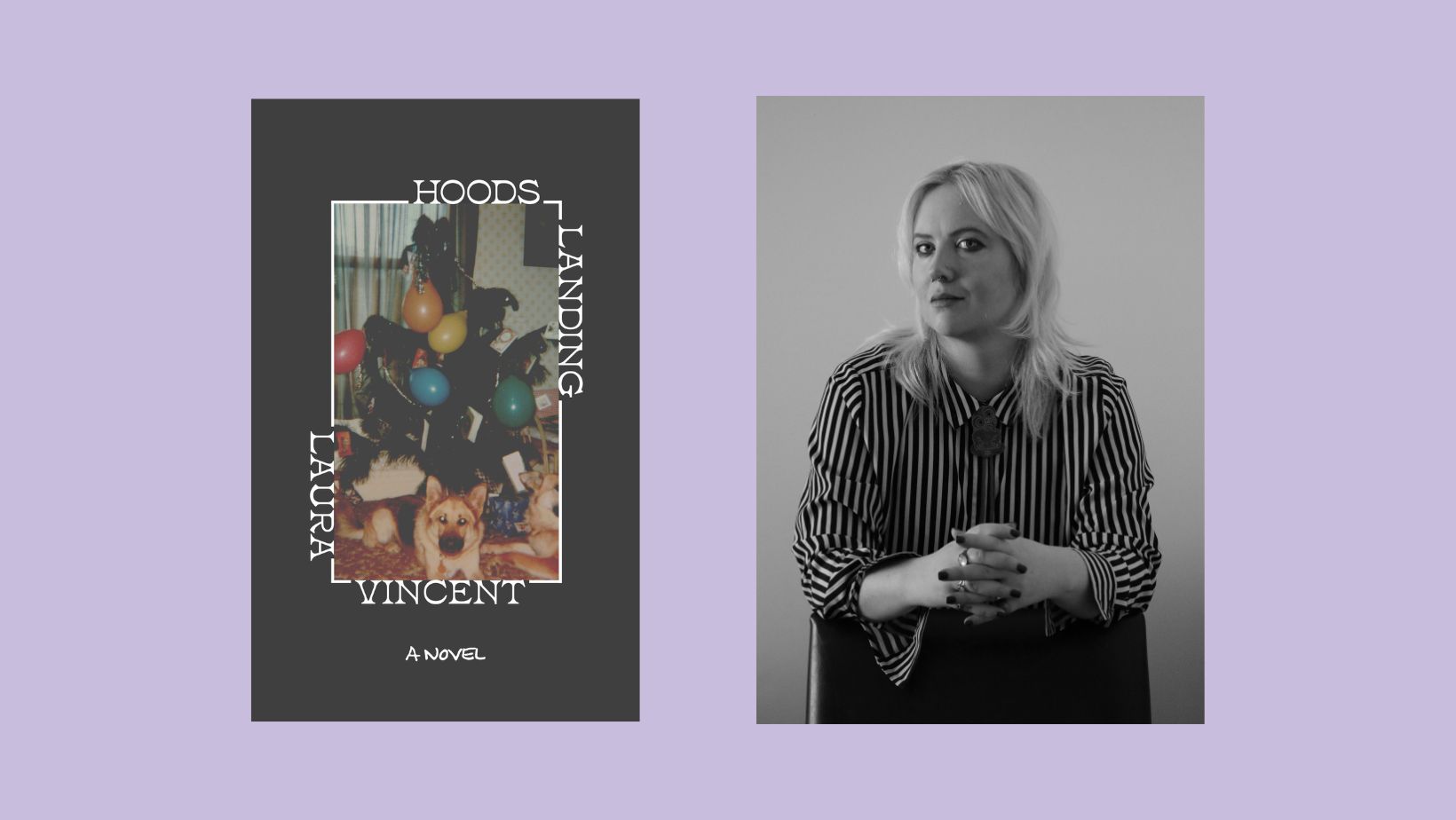
To celebrate the release of Laura Vincent’s debut novel, Hoods Landing, two members of her writing group, Shot, Sappho, Holly-Blue Bercu and Anuja Mitra, put forward some questions about the book. In this short interview, some mysteries of Hoods Landing become a little clearer and others, a little more obscured.
Shot, Sappho: This book is very rich in sensory detail, in a way that makes the flow between past and present quite seamless. Were you aware of this while you were writing, or is the focus on the senses just something that comes naturally from your experience as a food writer?
Laura Vincent: Not to immediately resort to a meme, but nonetheless! I was literally standing inside my novel as I was writing it, naming five things I could see, four things I could touch, three things I could smell, and so on—it built up around me, I can feel it still, and I hope it’s as binaural for those reading it.
Describing food is my idea of fun, but these sensory details were significant to both the verisimilitude of moving through time, and for the act of moving itself—like the way certain scents time-travel you against your will. The loss of sense also demonstrates time’s cruel progression. Rita laments that Watties canned spaghetti is terrible now—her ache for a meal that can never again be tasted also stands in for a larger ache that she refuses to examine.
SS: While I (Holly) was reading the book, I kept being reminded of David Lynch saying, “Inside every human being is an ocean of pure, vibrant consciousness”. The way the book is narrated, it really feels like the characters are oceans of consciousness that we’re jumping between and swimming around in. I think that’s partly because of the vivid sense memories conjured by the prose, but I also felt like there was something self-aware about how the characters use tarot, dreams, religion, family history, and song to understand themselves and their lives. Did you build the story/characters around this idea, or was it the other way around?
LV: I’m sure there’s a long line of us having afterlife communion with David Lynch, but his voice does keep chasing me.
There are indeed blurry mergings and near-mergings between these characters. And the more they dig in their heels, the more they intertwine, like when you pull on a cable tie and it fixes tighter.
It’s also true that I wrote the story knowing characters would seek meaning and self-actualisation in haphazard and overlapping ways. The Gordons inherit this from 102-year-old Irene, who made a life of tarot seem coolly practical. Avery seeks God as an expression of her queerness, not in spite of it; Bufty names her children and dogs after movie stars, everyone’s lightly haunted by the midpoint between dreams and whakapapa, and Rita, who eschews meaning, keeps having metaphors and allegories thrust upon her.
Despite embarking on this with purpose, it felt as though Hoods Landing was making sense out of me in return—like the invented consciousnesses within it started to pool and ripple around me for real.
SS: The title is never mentioned in the text. Was this a deliberate choice, or did it happen organically? Is there any significance, personal or otherwise, to the name ‘Hoods Landing’?
LV: Good spotting. Deliberate.
SS: There’s a recurring theme of characters going off to cities and then returning to the rural village (especially Rita and Stevie). How have rural life and city life shaped you, and this novel, differently?
LV: Rural life shaped me twice: when I was born, a small-town baby with big city dreams, not belonging yet irritatingly of this place; and when I returned home in what you might politely call a fallow period as a big city big adult baby, on the dole and unable to drive, with fewer prospects than Charlotte Lucas. However, I also spent rare, precious time with my family, several of whom have since passed. All of this, in turn, informed Hoods Landing.
Sometimes I think about how if I were even marginally more functional, I wouldn’t have had this time with my family or Hoods Landing. Only one of these really matters, but it sure is nice to have had both.
SS: The novel’s first and final scenes culminate in song, and it’s peppered with references to music and pop culture generally, throughout. We’ve spoken about our mutual love of Mahler, Fiona Apple, and Limp Bizkit quite often—what other music has played a role in your life, including your family life? Did you have a go-to album/artist while writing Hoods Landing?
LV: I listened to a lot of opera, and film and television scores while writing and editing the novel—The Apartment, Hudsucker Proxy, Anatomy of a Murder, Ascenseur pour l’echafaud, Twin Peaks, The Hour. It was a little vicarious determinism—by which I guess I mean, manifestation—that while listening to Angelo Badalamenti or Duke Ellington paint pictures with music, perhaps my own scenes could rise to the occasion with their momentousness.
My whānau is bigtime musical and to be part of it is to be at peace with a lot of noise. As kids, my brother and I would fall asleep each night listening to a cassette of Dad’s band (which included covers—for a long time, I thought Dad wrote ‘Eleanor Rigby’). Family gatherings always gave way to singing, with signature songs and three-part harmonies on Happy Birthday to You. I also did ballet from age three, which built my love of classical music.
It made sense for the Gordon family to be this noisy, too. They’re not just talkative, laughing, arguing; they’re stuck in your consciousness through songs that loop in your brain. It’s both beautiful and inescapable. It’s also metonymical—I am probably misapplying this word—where a character’s musical taste stands in for and represents their actual characterisation.
My dad and brother are musical geniuses, but I can’t sing or read music. All I’ve got is appreciation, obsession, and Wikipedia-scavenged trivia. Although I see the Twins enjoying them, to their mothers’ confusion, I heroically resisted shoe-horning a Limp Bizkit reference into Hoods Landing for its own sake. Music references must be grounded in contextual truth!
SS: If you will excuse the cliché, art is never finished, only abandoned; and it is often the case with debut novels that they feel like they were abandoned at least two drafts too early. Nothing in Hoods Landing felt extraneous to us, and it also didn’t feel wanting at all, which is so remarkable for a debut! What was the drafting/editing process like? Did the initial idea for the novel come during your Master’s in 2022? How many iterations of the novel were there before you started working with the Whitireia team? How was it working with them, and are there any pearls of wisdom you could pass on to other writers from that experience?
LV: I recommend any author to engage with the Whitireia publishing programme, its students and their mahi—the level of care and collaboration was a real joy, and it’s an honour to have shared this novel with them.
There was only ever one real iteration of Hoods Landing. No abandoned endings, minimal deleted scenes. Not because I’m some kind of maverick—or at least, not that kind of maverick—but because the plot largely involves characters eating biscuits, not car chases or killer clowns, and I knew exactly how, when and why each character would eat a biscuit.
Notes app substantiation suggests I first planned this novel in March 2020. I was back living at home, lockdown had kicked in, and in that just-add-water stasis, I looked out the window at the neighbouring paddock and thought, “I could see an elderly lesbian standing there.” I added flesh to these bones at AUT in 2022 and spent the back half of that year proofreading and editing—at least I thought I did, until 2025 when the manuscript at last got fresher eyes than mine.
Ruby Leonard at Āporo and the Whitireia team brought what I lacked—logic, distance, genuine publishing knowledge. They sharpened details, identified blatant inaccuracies, created a beautiful book where every choice and design element has meaning. Like how applying toner to bleached hair turns it from rubber-duck yellow into a cool, silvery platinum. My pearl of wisdom is to be sure of your intent when questioned or challenged. I think ‘trust me, bro’ is equally as viable a response as an essay explaining the subtextual 5D chess game at hand, as long as you feel strong and sincere when you say it.
SS: If you were to use characters from the book as astrology placements, who would be your sun, moon, and rising? (Holly is an Avery Sun, Irene Moon, Stevie Rising; Anuja is a Bufty Sun, Rita Moon, Avery Rising.)
LV: I had a flippant response (“author self-insert Sun”), but sincerely, since there is no other way to talk about astrology, it is always changing. And everyone reading this has my permission to stop me on the street to tell me their Hoods Landing Big Three. I want to know.