

Stephen Rainbow, the Chief Human Rights Commissioner, is a Zionist. That he supports the genocidal Israeli occupation is a fact he made clear in his Israeli Institute article, ‘With every chant, Israel’s case grows stronger.’ It was published on 6 January 2024, at which time over 25,000 Palestinians had already been murdered, millions displaced from their homes, hundreds of Palestinian hospitals and ambulances destroyed, and UN-run schools used as shelters turned to rubble.
Last month, Rainbow was celebrated for his work in the national gay magazine Your Ex: ‘“Harmonious, Free, & Equal” – the Chief Human Rights Commissioner’s Hopes for a Polarised Aotearoa.’ Rainbow’s support of the genocidal Israeli occupation is reprehensible and deeply immoral. We, Pōneke Queers for Palestine, want to make it clear that his views are not representative of queer people in Aotearoa.
Pinkwashing Israel
An out gay man, Rainbow uses his gayness to justify his support for Israel. He writes that Palestinian treatment of gays is “barbaric”, while Israel is “one of the most gay-friendly countries in the world.” Rainbow is not alone in making such arguments—the Israeli government itself is well known for promoting Israel as a gay party destination when it suits them to do so.
In November 2023, Israel’s official Instagram account published photos of an Israeli soldier holding a rainbow flag bearing the words “in the name of love,” while standing on top of the rubble of Gazan homes that he helped bomb. To say that the juxtaposition is jarring—between this smiling soldier carrying a symbol of pride and the utter destruction behind him—is an understatement.
These tactics are known as ‘pinkwashing.’ It is Israel’s propaganda strategy of exploiting queer rights to create a positive, progressive image of Israel, and thereby legitimise Israel’s brutal colonisation and genocide of Palestine. It relies on racist tropes that Arab societies are conservative and homophobic, while Israel is liberal and holds modern Western values.
In reality, the biggest danger facing all Palestinians—whether queer or straight—is the Israeli occupation. In the two years between October 2023 and October 2025, the Zionist entity has murdered more than 67,000 Palestinians, 20,000 of whom were children. That is one child every hour. These numbers are only those officially recorded; the real number will be much higher, given how many Palestinians have been buried by the rubble of their bombed cities or gone missing. These figures do not account for the many thousands more who now suffer life-altering injuries, the destruction of critical infrastructure like hospitals and drinking water, and the Israeli-orchestrated famine.
Israel’s ‘gay-friendly’ hypocrisy is particularly clear in its long and well-documented history of blackmailing queer Palestinians to pressure them into becoming informants, including during the current onslaught. Al-Qaws, a prominent queer Palestinian group, explains that Israel’s sexual and gender violence is “an inherent pillar of its settler-colonial project.” The footage of Israeli soldiers posing with rainbow flags atop Palestinian ruins “only affirms what the Palestinian queer movement has been saying for decades: the Zionist colonial enterprise is predicated on the sexual abuse of Palestinians.”
Queer Palestinians cannot live freely or in safety until Israel’s occupation ends.
Even for queer Israelis, the ‘gay-friendly’ image promoted by Rainbow and others does not hold true; Israelis have reported a sharp increase in anti-gay violence under Netanyahu’s right-wing government.
Queers for Palestine
In 2014, Queers Against Israeli Apartheid Aotearoa crashed the Auckland Pride Parade to bring the Israeli Embassy’s use of pinkwashing to light. Stepping out in front of the Israeli Embassy’s pride float, activists unfurled a rainbow-patterned banner reading “No rainbow big enough to cover the shame of Israeli apartheid.”
Like Queers Against Israeli Apartheid, Pōneke Queers for Palestine understands that it is our duty, as queer people, to expose Israel and its supporters’ attempts to pinkwash the murderous Zionist regime.
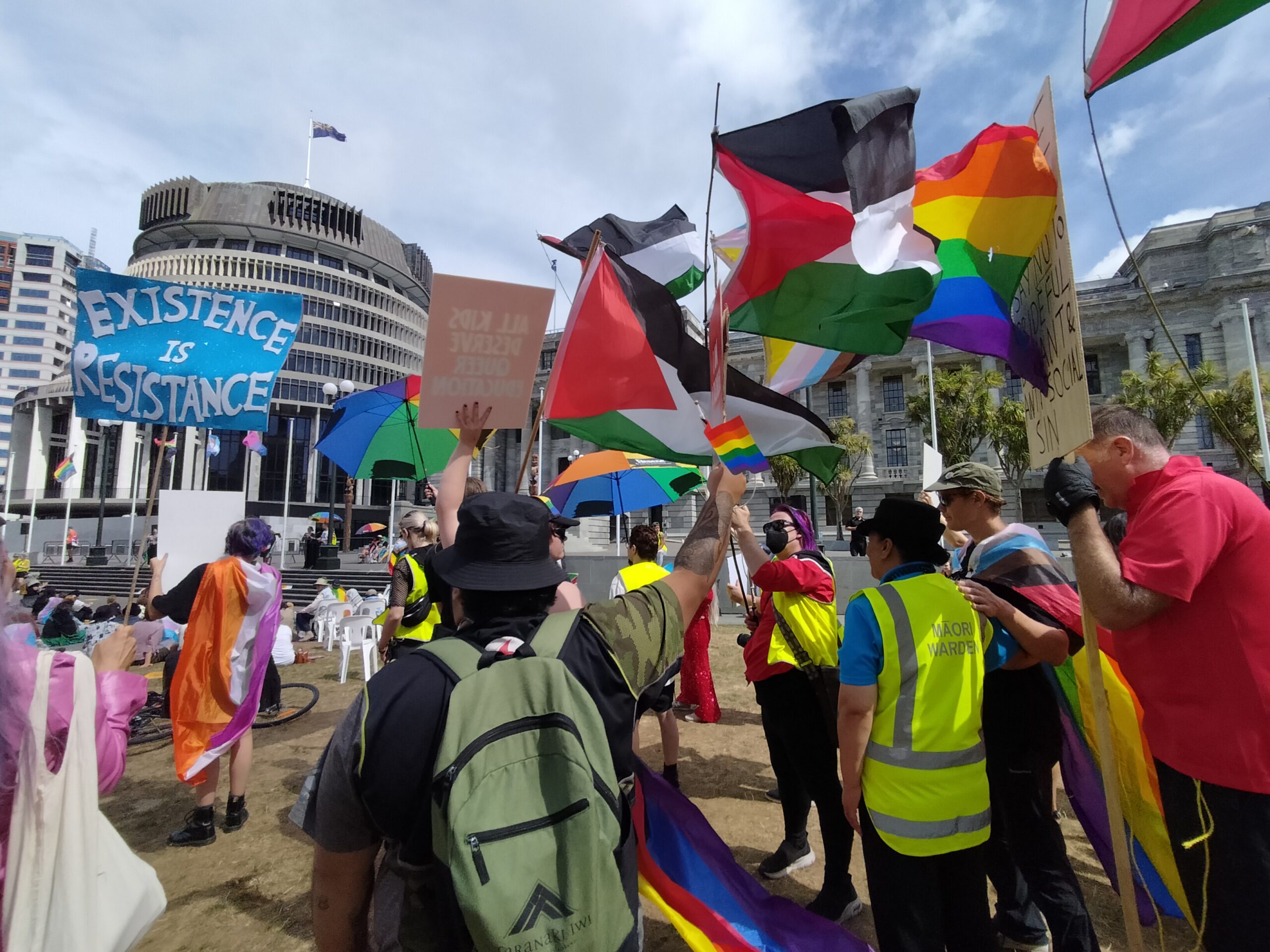
Over the past two years, the local queer movement in support of Palestine has grown significantly. In February 2024, queer activists challenged Prime Minister Christopher Luxon for his complicity in Israel’s genocide, and a month later, the Wellington Pride Hīkoi took to the streets in the name of three pillars: Mana Takatāpui, Toitū te Tiriti, and Free Palestine. Today, most queer events and protests will feature Palestinian flags and keffiyeh. At Palestine protests, you are almost guaranteed to read signs declaring “gays for Gaza,” “trans for Palestine,” and “no pride in genocide.”
Polarisation and Debate
Out of touch with local queer communities standing with Palestine, Rainbow uses the language of peace and civil debate to mask his support for genocide and war.
In Your Ex Rainbow bemoans the polarisation of politics, that today there is “less appetite” for “bridging conversations.”
On the one hand, Rainbow tells us he is desperate for a respectful debate. On the other hand, he precludes any critique of his views by arguing that “when you label someone with a different view as a ‘bad person’, you erode their dignity, and their human rights protections, by dehumanising them.” Rainbow seems more concerned for his own reputation than he is for the dignity and dehumanisation of Palestinians, living in tents and dealing with famine created by Israel. If support for a genocide does not qualify someone as a ‘bad person,’ then what does?
How can there ever be ‘reasonable debate’ when Israel is denying desperately needed aid trucks from entering Palestine? Rounding up and torturing civilians? Bombing hospitals and schools? Reducing entire cities to rubble, burying countless humans in the process? When Israel has illegally and violently occupied Palestine since 1948?
Intergenerational Dialogue
While Rainbow only briefly mentions Israel in his Your Ex article, it is a clear subtext. His other chief concern appears to be doing damage control after The Spinoff exposed his anti-trans comments when he was first appointed last year. In 2021, while working at Auckland Transport, Rainbow commented on a Facebook post encouraging people to sign a petition calling to ban conversion therapy, writing: “be careful…there’s some elements of the trans agenda being sneakily promoted through this campaign.” As The Spinoff’s editor Madeline Chapman wrote, “believing that there is a scary ‘trans agenda’ behind the criticism of conversion therapy is a literal representation of trans-phobia.”
While it is true that people can learn and grow, Rainbow’s comments to Your Ex suggest his growth has been limited at best.
Rainbow tells Your Ex that his “trans agenda” comment reflected a “misalignment between generations,” a shift “from a focus on same-sex rights to a broader movement.”
This is an odd justification for holding anti-trans views. Though often overlooked, trans people have always been active in Aotearoa’s queer political movements, including homosexual law reform and marriage reform. Moreover, since at least 2019, there has been a renewed, strong and vocal trans movement pushing back against the rise of anti-trans bigotry. At a rally organised by Queer Endurance in Defiance in July 2021, held outside an anti-trans lobby group meeting, long-time gay activist Bill Logan spoke out in support of trans communities. He reflected on the 1985-6 campaign to decriminalise homosexuality—where he was one of the most prominent spokespeople—as an “extremely similar struggle in many ways.” To cheers, Logan informed the crowd:
“There were so many meetings of small groups of people saying vile things, but occasionally also saying ‘oh we love you, we pity you’, and then going back to saying their vile things…and there were, outside those meetings, gatherings like this. Gatherings that represented ordinary New Zealanders of every type, of every gender, every sexuality. Demonstrations like this represent justice, and they represent the future. They represent better lives for our people.”
Logan is one of many cisgender queer elders who have been staunch defenders of trans communities. Rather than use the challenges they faced in their own youths as a way to justify opposition to trans struggles, elders like Logan recognise that all these struggles are deeply intertwined.
In Your Ex, Rainbow makes a plea that elders have not “fully passed on their stories,” sat down “with younger rainbow people” to explain “this is what it cost.” This argument is not only unfounded—as the work of Logan and others proves—it is also utterly disrespectful.
Rainbow ignores all the elders, historians and archivists who have spent years and years of volunteer time connecting generations and educating our communities. Many of these individuals do so because they recognise the precarity of the current moment, the continued oppression queers face and the ways trans communities are being targeted.
Rainbow feels that young people have no appreciation for “just how challenging” the lives of elders were. This is dismissive and, again, unfounded. Young people all over Aotearoa are working to honour queer histories, from the crews of volunteers working in Kawe Mahara Queer Archives Aotearoa and the Charlotte Museum, to the activists of Queer Endurance in Defiance who consistently honour queer ancestors at their protests.
If Rainbow truly wanted to support trans communities, why has he spent his time in this Your Ex piece extolling the difficulties of his own life and dismissing the challenges and work of others? Rainbow does not acknowledge the attacks trans communities are facing, such as the bills being drafted by New Zealand First to define trans people out of existence, or Destiny Church’s repeated attempts to intimidate queer people out of public life. What is he, as Chief Human Rights Commissioner, doing about this? We are left in the dark.
In this context, Rainbow’s plea for civil debate again must be scrutinised. How can debate be reasonable or safe when one side wants to deny trans people the right to access medical care, to learn about themselves in school, to join community sports teams, to use public bathrooms, and simply to be themselves? And the other side simply wants to exist?
Stephen Rainbow Disregards Human Rights
It is laughable that someone who so clearly disrespects the human rights of Palestinians and trans people is the Chief Human Rights Commissioner.
We, Pōneke Queers for Palestine, stand with Palestinians as they endure this live-streamed genocide at the hands of Israel. Stephen Rainbow, and all who pledge allegiance to the Israeli state, do not speak for Aotearoa’s queer communities.
Only through solidarity with Palestinians, and all the world’s oppressed people, will queer communities ever be free.
Photo supplied by Will Hansen.