
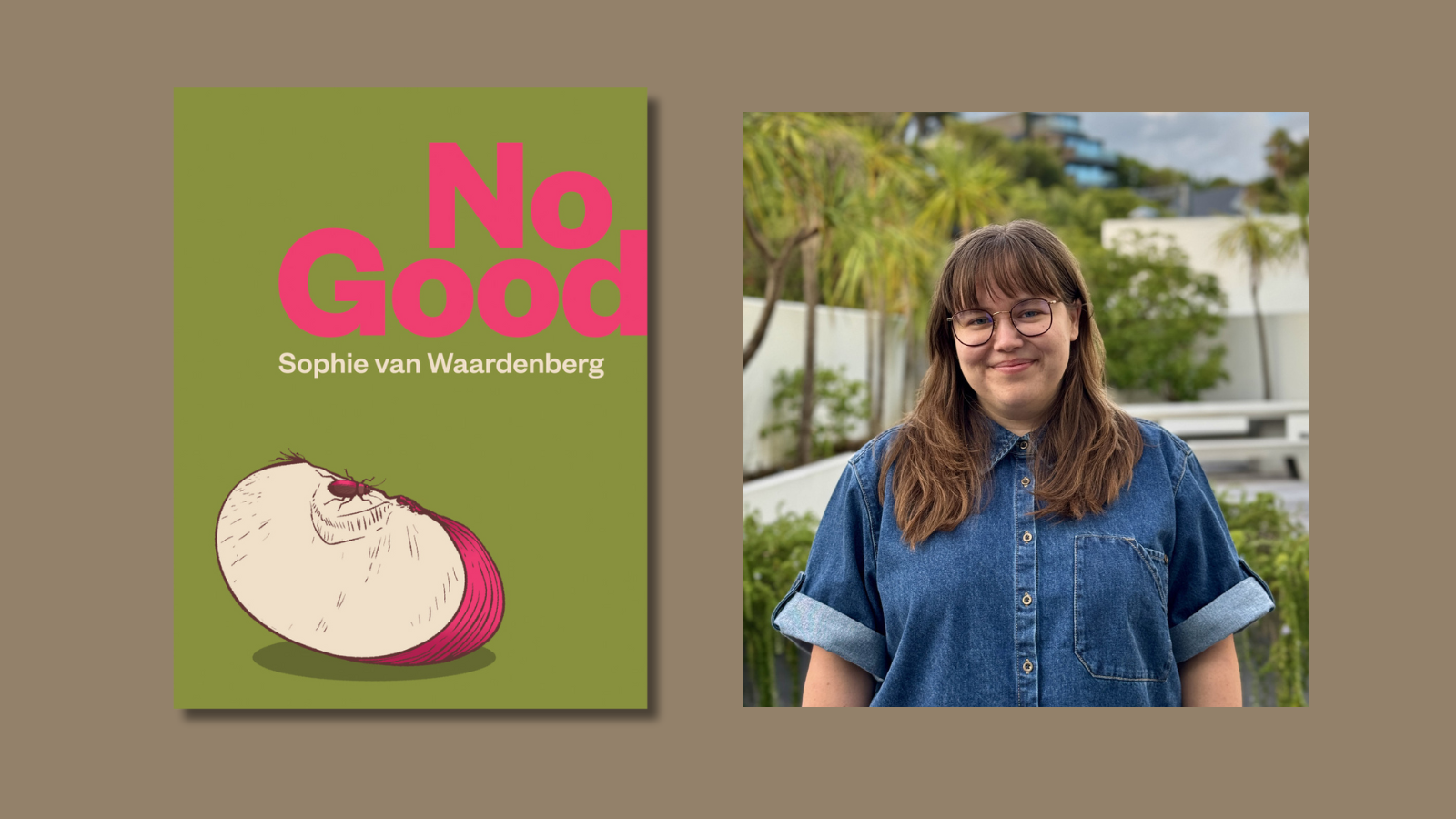
A review of No Good by Sophie van Waardenberg followed by a Q&A with the author
Sophie van Waardenberg is a writer from Tāmaki Makaurau. She holds an MFA from Syracuse University, where she was editor-in-chief of Salt Hill Journal. Her first chapbook, ‘does a potato have a heart?’, was published in AUP New Poets 5 (2019). Her poems about eating carbohydrates and kissing girls can be found in Cordite, Sweet Mammalian, The Spinoff and Best New Zealand Poems. Her debut poetry collection is No Good (2025).
Every poet has their favourite words, words that recur across a collection or body of work, reminding you whose voice you are in. I have a theory that these can tell you quite a lot about a writer: where the heart of their work resides, and what they most struggle and long to say. In Tāmaki Makaurau poet Sophie van Waardenberg’s extraordinary debut collection, No Good (AUP, 2025), the favoured words seem to be good, green, and grace—and, above all, love.
This is a collection earnestly about love and heartbreak, which van Waardenberg suggests are not just related phenomena, but perhaps the same thing. To grieve is to love; to love is to anticipate grief. This is clearest in the collection’s luminous series of ‘Cremation Sonnets’. The speaker of these sixteen poems has lost a father to illness while she is on the cusp of adolescence. The tone of the sonnets—by turns petulant, desolate, matter-of-fact, wry, furious, and doubtful—is a profound representation of the many moods of grief. Stray lines pursued me for weeks after reading: “Dead dead traveller, what song is it, / when you come back, that you sing?”; “the rank and perfect / onliness of my loss”.
The beauty of these poems is hard to overstate: they manage to be precise but not fussy, lyrical but not cloying, vulnerable but never self-indulgent. Of particular note is their formal variety. Here, there’s a sonnet made entirely of questions; a sonnet of run-on sentences rendered staccato by abrupt capitalisation; a long-breathed, single-sentence sonnet; sonnets of sing-song anaphora. Nimble and gorgeous, these poems are the work of both a master craftsperson and someone who has sat with her subject matter long enough to have really metabolised what she has to say. I doubt a stronger poetic sequence will be published in Aotearoa this year.
The collection’s many love poems—whether addressed to lover, brother, dear friend—are similarly subtle. Each features moments of wonder and pleasure: “In the pockets of air between us, there was warmth, / there were no questions” (‘Love Poem’); “Master of sweetness, how on earth did I get you?” (‘Grace from a Distance’). But each love poem is undercut also by a fear of loss, or the recognition that losing love changes its meaning in retrospect—by moments like this: “Darling for some hours yesterday / the buildings hung around us large and still – / / I could see the clouds swarming your face. / I couldn’t tell you anything” (‘Bringing Each Other Shrubberies’). It is this sensibility—the feeling that loving is easy and extremely difficult, somehow at the same time—that defines the collection.
The deftness of van Waardenberg’s treatment of serious subjects is not to say her work is without humour. Who could resist the image of two flatmates “attempting nutrition” (‘Midnight, Fellows Avenue’), or the sheer fun of lines like “You continue to tromp and muscle and zoom / and I to comb and mumble” (‘Love Practice Weekend Four’)? Her speakers slip often into the voice of a child, who speaks with irresistible grumpiness and playfulness even when touching on darker themes—could there be a better description of depression than “you get everywhere, sog up my arms / / and droop me” (‘The Getting Away’)? Children say what they mean; it sets them apart from adults. The speaker of the opening ‘Poem in which I am good’ promises herself:
Everybody I love will live forever.
Everybody I love will live forever.
But every adult knows that wish, and the depth of longing that makes one repeat it like an incantation.
Among the collection’s pleasures is its dedication to sound. Quite aside from its literal content—whether a reference to The Beatles or the pianist girlfriend at the heart of the third section—van Waardenberg succeeds in getting just about every line to sing. There are fantastical moments of sound play: “[t]he eely weed / trying something against my heel” (‘Cremation Sonnet [15]’), or a pair of lovers “ossifying, simplifying, / melting, wasting, humming, stewing, fritzing” (‘Love Poem’). At other times, sound is meaning. A verb-light line like “But listen, a houseboat—the mornings so morning, / the evenings so clean” (‘Hymn to Twee Possibility’) is carried along on the momentum of its own music; the hope of the houseboat is contained in the phrasing itself.
At its best, many of the poems in No Good feel not only good, but perfect—which perhaps comes down to their purity of voice, their particular idiosyncratic sound. I defy anyone to change a single beat of the nine couplets of ‘Self-portrait as an adolescent covered in flour’, or the lullaby of ‘Sticky’, with its haunting close:
A girl is held inside a duck’s bill, weighed
against a slice of bread for softness.
What flour is a girl made of? Wheat or corn?
How can a girl get clean again?
In the final poem, the speaker asks: “how do we go on. No, really. When it’s over / / all the time?”. But the collection has answered this question, over and over. Van Waardenberg manages in sixty pages to move, charm, stun, and tickle; belying its title, her collection is very good indeed.
A Q&A with Sophie van Waardenberg
MB: How long have you been working on No Good , and what was the process of writing it like? How has it been different from writing your AUP New Poets 5 chapbook, ‘does a potato have a heart?’?
SvW: The first poem in the book is one I wrote when I was 22, so I guess the book was about six years in the making. That feels absurd, really. During that time, I wrote so many more poems that didn’t make it into the book, poems that weren’t ever seen by anybody and—I don’t know why I’m trying to justify those years. I don’t think I was ready any earlier.
I worked on most of the poems in the book during my MFA at Syracuse University, which was three years long. It was a gift. One semester in, the pandemic hit, and there wasn’t much else for us to do anyway, apart from panic and write. There were a few months when I’d write a poem or two a day. Not many of them were worth keeping, and most of them were just about sitting down inside, but that’s the same as always.
So yeah, I wrote a lot of the book in Syracuse, and then in New York City, where I lived for a little bit after that. Once I was back in Aotearoa, I didn’t add many poems to the manuscript, but I kept editing for ages—and of course, the editing is the writing, it’s where so many of the decisions happen.
No Good is obviously longer than ‘potato’—what a thing to get to say!—and there’s nobody else, no other New Poets keeping me company here. That chapbook was more a bundling together of recent work that I didn’t mind having published, a marker of where I was at as a very young poet. It felt casual, in a way; I don’t remember worrying too much about it. This book, on the other hand, required me to think about it as a whole thing: how it would begin, where it would end, how to make sense of the order. I think the whole final year of work on the book was just about deciding which poem would go before or after which other poem.
MB: How are you feeling now that it’s out in the world?!
SvW: I am a little bit afraid, Maddie! But I think the two quite practical things I knew I would get out of having the book published—having something to hold in my hands, and being able to move on from all these poems and write something else—have been or will be accomplished, and that’s really helpful.
Whether the book is actually ‘good’, whether anyone will ‘get anything out of it’: I know those questions are not really relevant or answerable or helpful, so I’m trying not to ask them. It’s hard, though. There’s a very good essay by Emily Berry that talks about how perplexing it is to be published as a poet. I was going to quote from it, but I realised I’d have to quote the whole thing.
No Good has so much of me in it, so much of my childhood, my desires, the people I love, my funny little brain, so it’s really weird for that to be all in one place, a physical object with a price attached to it. I’d like to use the trusty old ‘The Speaker of My Poems Isn’t Me’ excuse or pretend that the book is full of lies, but it’s ended up being pretty honest, unfortunately. Poetry is embarrassing. I wish I were a nature poet or someone who wrote stories about aliens so I could mostly avoid feeling this way.
MB: What does your writing practice look like?
SvW: I wish I knew the answer to that. Then I would just do it! It’s different all the time. But I think I’m almost always in a mode of gathering—fragments of speech, the way stuff looks and sounds, slogans and labels and lines from movies. Always trying to listen and remember. A big, clumsy magpie. Or a spy without an assignment. I have about five notebooks littered with those bits and pieces, plus the notes app on my phone (including notes titled ‘new notes’ and ‘newer notes’), and maybe one day soon I’ll sit down and make something out of some of it. But gathering and recording, even if that’s all I’m doing, takes away a bit of the anxiety I often feel about not writing a whole lot in any given week or month. Or year.
Formal workshopping or just sending work to (select, beloved) fellow writers is also really helpful for me. I find it very difficult to share drafts, actually, it feels disgusting, but I think that’s part of why it’s also a good thing to do, at least some of the time. It takes a bit of the self-important mystique out of the process. The readers I trust can tell me when I don’t sound like myself, or when something is too fresh to write, or that I’m failing to communicate what I thought I was saying clearly. Something I learnt, or tried to learn, in my time in an MFA workshop was how to deal with feedback: when to listen to it and when to throw it out. Sometimes you need to stick with a line that everyone else hates. Poetry is not a democratic process! But it might be helpful to know they hate it anyway. It can be just as galvanising as getting lots of nice compliments. You can stomp all the way home and write something better.
MB: Do you have a current favourite poem in the collection?
SvW: I don’t know if ‘favourite’ is the right word to use. The ones I’m most fond of now are the ones with my friends in them, and the ones addressed to my friends. ‘Hymn to the Insomniac in Fool’s Spring’ is one of those. I love my friends. I love that I can put them in my poems, that they’re there forever. That sounds a bit horrible, but actually it’s very nice.
MB: Which writers/artists/musicians served as inspiration for this collection? Which poets are you reading, at the moment and always?
SvW: The middle section of the book—the sequence of ‘Cremation Sonnets’—was definitely emboldened, if not directly influenced, by Emily Berry’s collection Stranger, Baby and Sufjan Stevens’s album Carrie and Lowell, works of art that have kept me company for about a decade now. When I first heard that album and read that book, I was startled by how they seemed to get to the centre of grief. I mean, grief is unwritable. It doesn’t have a centre. It’s hard to explain to you what I mean. But Berry and Stevens showed their working out, their repeated attempts, in a way that feels true without getting boring or cold or dour. I wanted to do that too, to write the loss that had followed me around for so long, even to get a bit obsessed by it all over again, but not only to wail.
I also think a lot of No Good has its deepest roots in the music that I heard over and over as a kid. The sugary love songs of The Beatles; simple wistful Cat Stevens; the chatty, kind of annoying lyricism of Paul Simon; Ella Fitzgerald’s voice, which always sounded like a smile to me. I think I am trying in my poems to find the lyrical impetus that songs have. Poems are good poems, to me, when they come from a voice that is singing, even if their forms aren’t particularly songlike.
What am I reading? I have just read and delighted in Anna Jackson’s hybrid poem-essay collection, Terrier, Worrier: so lucid and exact, and warm and vulnerable too. I’m also having a great time with K Patrick’s collection, Three Births. Very queer and cool and cracklingly alive, and in it there’s a poem about George Michael, which might be the reason I picked it up in the first place.
And as for who I’m always reading: it’s Frank O’Hara. A rude thought I have too often is that poetry is actually boring and not good, and I’d rather just watch old episodes of Grand Designs. But how can that be true when we have Frank? Rilke, too. And of course, of course, so many others. In the more contemporary camp: Mary Ruefle, Hera Lindsay Bird, Emily Berry and Jack Underwood.
MB: No Good suggests you’re a poet fond of sonnets and couplets, especially. What draws you to formal constraints?
SvW: It’s good to have somewhere to start: a shape to fill. The sonnets mostly owe their existence, boringly, to a class on sonnets I took at Syracuse. In that class, we read, unsurprisingly, lots and lots of sonnets. Diane Seuss, Wanda Coleman, Terrance Hayes, Shakespeare, John Donne, Edna St. Vincent Millay, on and on. And then we wrote lots and lots of sonnets. It was the first time I had worked with any real intention on a sequence of linked poems. Once I’d started, I got a bit consumed by the project and didn’t stop for ages.
You can call lots of things a sonnet and hardly anyone will tell you off (and who cares if they do). For me, they’re good containers because you have to be a bit declamatory, a bit argumentative, and then you can betray yourself, you can cast doubt on the whole thing, you can shrug the whole thing off and go out into the sunlight. And you have to do it all quite quickly.
Working in metre is also helpful for me sometimes: like rhyming, it forces you into all sorts of weird contortions that change your attitude, your voice, the core image. You get shaken up a bit. Whatever’s left of pentameter in the sonnets of No Good is scant and camouflaged, but there’s definitely still some there.
I’m so fond of couplets too, you’re right. There’s no proper reason. I’ll usually try out lots of different forms for a poem, but the couplets tend to come right back. I like the way your eyes move down the page when a poem’s in couplets. I like the way they let a bit of air in but keep the rhythm going. They’re quite vulnerable: they leave every word exposed to blank space so you can tell when you’re getting sloppy. And they open up lots of possibilities by suggesting pairings, which is so much of the point of poetry for me. What if we put these two things together? How would that sound?
No Good by Sophie van Waardenberg will be published on 14 August 2025, with a launch event held at The Open Book in Tāmaki Makaurau, featuring readings from bad apple alumni Zephyr Zhang and Amy Marguerite.
You can preorder the collection directly from Auckland University Press.